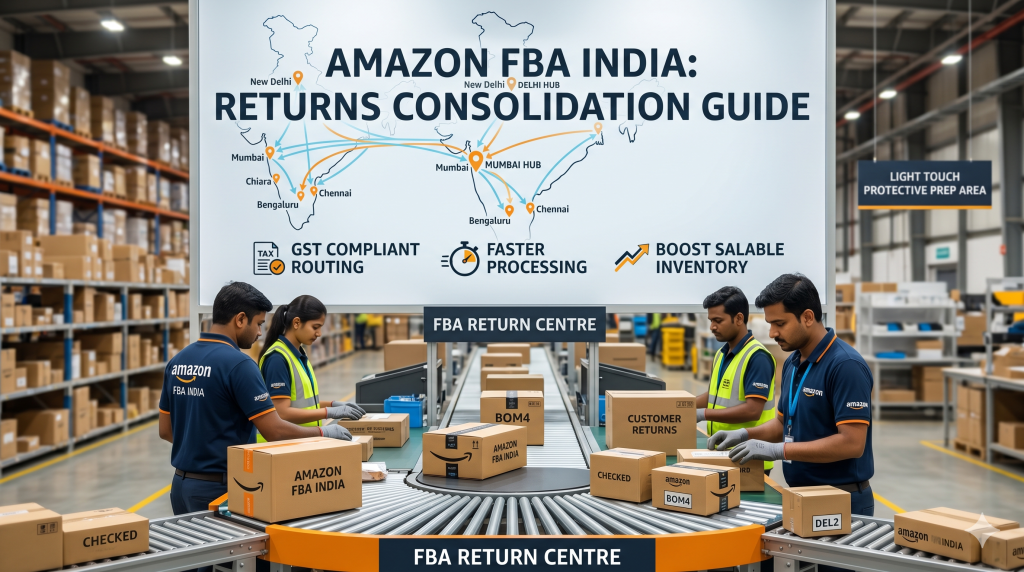
If you are running an Amazon FBA (Fulfillment by Amazon) business in India, customer returns and undelivered shipments (Return to Origin, or RTO) are an unavoidable cost of doing business. Across categories like fashion, return rates can soar as high as 30% to 40%. Historically, dragging those returned products back across the country wrecked profit margins.
Amazon FBA Return Consolidation.
This logistics framework radically alters how returns are handled across the Indian ecommerce landscape. This guide breaks down what Return Consolidation means for your business, its impact on your bottom line, and how to navigate the strict GST compliances that come with it.
What is Amazon Return Consolidation?
Amazon Return Consolidation is a logistics program where customer returns and undelivered orders are routed to the nearest designated regional Return Centre (RC) or consolidation hub rather than traveling all the way back to the original Fulfillment Center (FC) from which they were shipped.
For example, if you store your inventory in a Chennai fulfillment center but a customer in Delhi returns your product, Amazon will route that item to a North India Return Centre (like DEL2 in Haryana) instead of shipping it thousands of kilometers back to Chennai.
Traditional Returns vs. Return Consolidation
To understand why this matters, look at how the inventory workflow changes under this program:
| Feature | Traditional FBA Returns | Same-State Return Consolidation | Interstate Return Consolidation |
| Transit Distance | Long-distance (Customer to Origin FC) | Short-distance (Customer to Regional Hub) | Short-distance (Customer to Nearest Hub) |
| Transit Damage Risk | High (Extended multi-state transit) | Low (Localized regional transit) | Low (Localized regional transit) |
| Reimbursement Processing | Slower (Tied to origin arrival) | Faster (Quick regional check-in) | Faster (Quick regional check-in) |
| Average Salability Yield | ~50% | ~60% (Due to specialized prep) | ~60% (Due to specialized prep) |
| GST Requirement | Default Home State / Primary FC | Local State APOB required | Multi-State VPOB & APOB required |
The Big Benefits: Why You Should Care
1. Reduced Product Damage
Long-distance transport is the number one killer of returned inventory. Every touchpoint, sorting facility, and bumpy highway increase the odds of your product returning as “Customer Damaged” or “Defective.” Localizing the return path cuts transit time and drastically reduces write-offs.
2. The “Light Touch Protective Prep” Secret
Amazon has equipped these dedicated Return Centres with advanced recommerce capabilities, including FBA Light Touch Protective Prep services. RCs are optimized to inspect, clean, re-evaluate, and repackage items far more efficiently than standard FCs. This shifts your inventory yield—boosting the number of returns classified as “Sellable” by roughly 10%, directly protecting your cash flow.
3. Accelerated Reimbursements
Because the product reaches an Amazon facility faster, the return is processed and graded much sooner. If you need to file a Safe-T claim or if Amazon owes you an automatic reimbursement for carrier damage, the payout clock starts moving days earlier.
The Catch: Strict GST & APOB Compliance
While this program has zero additional Amazon program fees, India’s Goods and Services Tax (GST) laws mean it isn’t entirely free of administrative work.
Moving returned inventory to a regional Return Centre constitutes a branch transfer. To legally allow Amazon to add those units back into your pool, you must register the designated Return Centre as an Additional Place of Business (APOB) on your GSTIN for that state.
The Risk of Ignoring This: If an item is processed at a hub like BOM4 (Maharashtra) or DEL2 (Haryana) and you do not have that specific facility listed as an active APOB on your GST certificate, Amazon cannot legally generate a Stock Transfer Report (STR) or assign that inventory back to your account. Your stock effectively becomes gridlocked.
How to Set Up Return Consolidation
While intrastate (same-state) routing is largely automated if you already hold the state’s GSTIN, unleashing the full power of interstate return consolidation requires an active opt-in. Here is how to complete the onboarding process properly:
1.Submit Your Program Consent:Step 1.
Look for an onboarding invitation email from in-fba-returnconsol@amazon.com or open a case in Seller Central requesting access to the Interstate Return Consolidation onboarding form. Complete the digital consent form to express your intent to join.
2.Extract the Designated RC Addresses:Step 2.
Once accepted, Amazon will expose the specific regional Return Centres assigned to your account (e.g., BOM4 in the West, DEL2 in the North) within your Seller Central dashboard under Settings > Account Info. Secure the formal address details and the No Objection Certificate (NOC) provided by Amazon for those facilities.
3.Register the Hubs as APOB on the GST Portal:Step 3.
Log into the official government GST portal. File a core/non-core amendment application to add these Amazon Return Centre addresses as an Additional Place of Business (APOB). If a hub is in a completely new state where you do not have a tax presence, you may first need to acquire a Virtual Place of Business (VPOB) to generate a state-specific GSTIN.
4.Upload Your Updated REG-06 Certificate:Step 4.
Once the tax department approves your amendment (typically taking 10 to 20 working days), download your updated REG-06 GST Certificate. Upload this document into Seller Central. Once verified by Amazon’s tax team, inwarding and recommerce flows will dynamically activate for those regional hubs.
Monitoring Your Returns & Accounting
Every month, usually by the 6th day, Amazon generates a comprehensive Stock Transfer Report (STR) detailing the movement of your returns into these consolidation hubs.
To download this for your monthly tax filings, navigate to Reports > Tax Document Library > Merchant Tax Report > Stock Transfer Report. You can use these transaction IDs to request formal branch transfer invoices from Selling Partner Support, ensuring your input tax credits (ITC) reconcile